

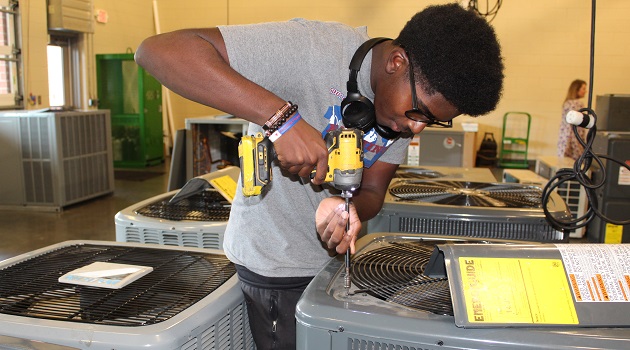
IRMO, S.C. — Students at the Center for Advanced Technical Studies (The Center) are gaining hands-on experience and industry-ready skills through the school’s HVAC program, a career-focused pathway designed to prepare students for opportunities in the heating, ventilation, air conditioning and refrigeration (HVAC/R) industry.
The HVAC program launched in August 2025 as a new program at The Center and is now entering its second year. Designed for students who enjoy working with their hands and want to develop technical skills, the program is open to students in grades 9–12 throughout School District Five. Students are encouraged to begin the program in 10th grade to take advantage of the full two-year sequence.
“The HVAC program is an excellent example of how The Center prepares students for life beyond high school,” said HVAC Program Instructor Devin McBride. “Students are not only learning the theory behind HVAC systems; they are developing the technical skills, problem-solving abilities and workplace habits that can help them succeed in a high-demand industry.”
During HVAC 1 and 2, students are introduced to the fundamental principles, practices and technologies used in the HVAC/R industry. The courses use the NCCER curriculum, a standardized, modular training program for the construction and maintenance trades developed by the National Center for Construction Education and Research. The curriculum is combined with classroom instruction and extensive hands-on training.
Students develop foundational skills in workplace safety, hand and power tools, basic electrical systems, HVAC components and system operation. They learn to read electrical and wiring diagrams, install and replace HVAC motors and common components, perform high- and low-voltage wiring, and install, configure and program thermostats.
By completing HVAC 1 and 2, students develop the foundational knowledge and skills needed for entry-level employment or continued technical training. Students who successfully complete the first year also have the opportunity to earn OSHA 10 and NCCER Core Curriculum certifications.
Students who continue into HVAC 3 and 4 build on their foundational knowledge through advanced technical training focused on residential and light commercial HVAC systems. Using the NCCER curriculum, students gain experience with advanced electrical and mechanical systems, installation, troubleshooting and service.
Hands-on training includes gas furnaces, heat pumps, air distribution systems, copper and plastic piping, ferrous metal piping, soldering, brazing and refrigerant systems.
By the end of the second year, students will have developed skills necessary to install, commission, diagnose and troubleshoot HVAC mechanical systems. Students also have the opportunity to earn EPA Section 608 certification, an industry-recognized credential required for technicians who work with regulated refrigerants.
Graduates of the program will be prepared to pursue entry-level employment, apprenticeships or additional post-secondary education and training in the HVAC/R field.
“Programs like HVAC give our students the opportunity to connect what they learn in the classroom to real-world careers,” said School District Five Career and Technical Education Director David Prigge. “We want our students to graduate with options, whether they choose to enter the workforce, pursue an apprenticeship or continue their education. The Center provides an environment where students can develop valuable skills, earn industry-recognized credentials and begin building a pathway toward a successful career.”
The Center serves students in grades 9–12 throughout School District Five and offers specialized courses in 17 Career and Technical Education programs.
The Center recently announced three new courses: Drone Technologies, Farm Animal Production, and Baking and Pastries.
Other CTE programs offered at The Center include Aerospace Engineering, Agriculture/Wildlife Management, Auto Repair Technology, Bioengineering Systems, Biomedical Science, Building Construction, Culinary Arts, Cybersecurity/Networking, Digital Art and Design, Electrical Systems, Civil Engineering, Law Enforcement, Fire and Rescue, Media Technology, Veterinary Science and Welding.