

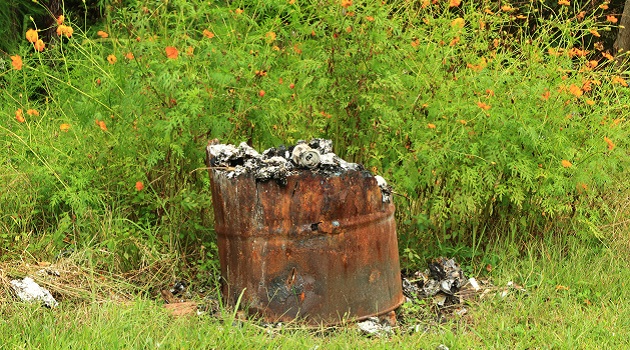
A rare sight today, the burn barrel
By Tom Poland, A Southern Writer
TomPoland.net
We had one. It stood on bricks near a tangled thicket of fragrant honeysuckle. I remember its strangely pleasant smell of burning paper, melting plastic, and blazing trash. I still hear the pop of exploding aerosols.
The burn barrel. It was a pragmatic way of life in times when no trash pick-up services existed. No carts to wheel out to the highway. Just a 55-gallon oil drum with holes in its bottom repurposed to man’s, dare I say, wasteful ways.
The years rolled by and I never saw one in its full glory, ablaze, snapping and a’poppin’, spreading its low haze across my parent’s yards. I came close, though.
On a recent Sunday back-road drive I came across a burn barrel. You could say it’s burn out. A dead 55-gallon burn barrel with a natural funeral spray of orange cosmos, a wildflower, behind it.
Today, except in the hinterlands, the burn barrel is passé. I have no idea where a garbage-burning man can get a 55-gallon oil drum today. I don’t recall where Dad got ours. We ran through a good many. We’d get a new one and by the time it had rusted up all flakey and corroded, collapsing from its own weight, we’d haul it off to the dump. Its bottom contents looked like tar … I imagine that was some toxic stuff. So, was the burn barrel a better way than huge landfills? Read on.
Now and then I drive I-20 to the Carolina coast. Along the way I catch a whiff of something akin to old pizza over-spiced with garlic. My nose, like a weathervane (in more ways than one) turns to the south and a massive landfill rises. It’s one of South Carolina’s largest municipal solid waste landfills. It covers roughly 120 to 200 acres, with the waste pile rising as high as 140 feet.
Locals refer to this “mesa” or mountain of trash as “Mount Trashmore” or “Trash Mountain.” Its permit allows an intake of up to almost 2 million tons per year. A large share historically has been out-of-state waste from places including New York and Massachusetts. A degraded outdoor experience, lawsuits, and a lot of money to the county have resulted. Money generally brings trouble doesn’t it? So, which is worse? Families using burn barrels or a massive landfill that riles people up and fouls the air?
Well, the verdict says burn barrels are worse. Hard for me to believe but the culprits are pollutants as you’d expect. Burn barrels’ poor combustion creates dioxins. Their effects include cancer, endocrine problems, damage to the immune system, and skin lesions. While they’re more often absorbed through the diet, inhalation or skin contact is a dioxin pathway near strong local sources, i.e. a burn barrel.
These long-lasting, fat-soluble toxins form mainly as combustion byproducts, concentrate in the food chain, and pose significant health risks even at low doses. Burning of household trash efficiently creates dioxins and releases them right at ground level. That would be a burn barrel or plain old trash pile.
Pushing a garbage cart out for pick-up the rest of your life? It’s not pleasant and neither is its smell at times. We never had to soap up and wash down the old burn barrel. Things change. Now we get to bury trash and refuse from up North. Some limiting factors considered, it would take 118 million burn barrels to fill a 200-acre landfill 100 feet deep. It would take roughly 100 to over 400 years for people to go through 118 million burn barrels. And we wouldn’t have to listen to those loud garbage trucks early in the morning, but we do what we must. But it seems to me, burn barrels would not harm the land and nature as much as a massive landfill does. Just my two cents.