

SCDNR Director shares thoughts from the SC7 trail about the connection of all things natural
By SCDNR Director Tom Mullikin
“When we try to pick out anything by itself, we find it hitched to everything else in the universe.” – John Muir
Everything in nature is connected. What do mosses, lichens, freshwater mussels, striped bass, box turtles, bats, chickadees, wild turkeys, white-tailed deer, bobwhite quail, waterfowl, and tourism have in common? In South Carolina, everything. South Carolina’s economy and natural story begin humbly and quietly, on a spray cliff where mosses and liverworts cling to life, and beneath the clear waters of our rivers where dragonfly larvae and salamanders hide under rocks. These are among South Carolina’s unsung conservation heroes. For example, lichens help create soil, recycle nutrients, and signal clean air. Freshwater mussels that are nature’s own water filtration system can filter gallons of water every day, removing sediment and improving water quality for countless species.
Those healthy waters become home to more than 150 species of freshwater fish, from colorful darters and redbreast sunfish to striped bass, catfish, and brook trout. And let us not forget the countless aquatic insects that are part of the food chain, feeding those same fish. Without clean water, thriving mussel populations, and healthy aquatic habitats, the fish that anglers treasure simply could not survive. In nature, even the largest gamefish depends upon some of the smallest and least noticed organisms.
From healthy soils and clean rivers come Piedmont prairies rich with native grasses and wildflowers, longleaf pine forests, cypress swamps, Carolina bays, maritime hammocks, and salt marshes. Together, they form one living landscape stretching from the Blue Ridge Escarpment to the Atlantic Ocean. These habitats support a myriad of plants, pollinating insects, amphibians, reptiles, songbirds, small mammals, and all the other wildlife that defines the biodiversity of South Carolina.
Bobwhite quail depend on healthy native grasslands rich with insects during their earliest weeks of life. Wild turkeys require mature forests for roosting, open woodlands for nesting, and abundant insects to nourish their poults. White-tailed deer browse on the diverse native plants that flourish in healthy forests and fields. Black bears roam mountain coves and coastal swamps alike. Remove one piece of this ecological puzzle, and the entire system begins to weaken.
That same landscape supports something else that is one of our greatest natural resources: South Carolina families. Our people hunt, fish, paddle, hike, birdwatch, photograph wildlife, or simply experience remarkable places like the Chattooga River, Jocassee Gorges, Congaree National Park, the Edisto River, the ACE Basin, Bull Island, Huntington Beach State Park, and Sassafras Mountain. These places are far more than scenic destinations; they are living classrooms where nature tells its story. That is why the South Carolina 7 (SC7) Expedition has become so important.
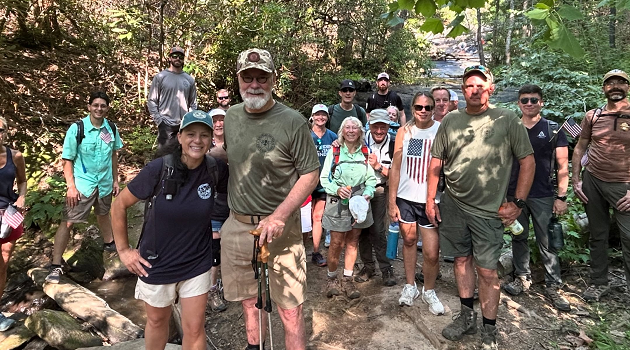
SC7 has helped shine a spotlight on our state’s extraordinary natural heritage through a 30-day journey from the mountains to the sea, showcasing South Carolina’s seven geographic wonders and the remarkable ecosystems that connect them. More than an expedition, SC7 is an outdoor classroom, inspiring citizens, students, and visitors from around the world to discover, appreciate, and protect the natural resources that define the Palmetto State. By bringing people up close and personal with forests, rivers, marshes, and mountains, SC7 demonstrates that conservation begins with every South Carolinian understanding that they are stewards of this extraordinary place.
Our economy is also deeply dependent on the conservation of our natural resources. From forestry to agriculture and tourism, each industry depends upon this living web. Visitors travel here because South Carolina offers something increasingly rare: healthy forests, abundant wildlife, clean rivers, productive fisheries, and breathtaking coastal landscapes. In many ways, South Carolina’s economy has the humblest beginnings with the often-overlooked species. Bats support our agriculture by providing a free pest control service while tender shoots, seeds, and insects feed the game and fish species about which sportsmen and women of the Palmetto State feel so passionately.
Conservation is often described as protecting individual species. In truth, it is about protecting relationships between soil and forest, forest and wildlife, rivers and fish, wildlife and people, and people and places. From the tiniest fern clinging to a mountain boulder to the crayfish in a blackwater tributary or the native brook trout in an Upstate mountain creek to the redfish gliding through a Lowcountry marsh, all of nature is interconnected and interdependent. Every thread of South Carolina’s natural heritage is woven into one extraordinary story, reminding us that we must protect representative examples of all types of species, habitats, and ultimately ecosystems.
John Muir understood that nothing in nature exists alone. Our beautiful Palmetto State reminds us that this truth is not merely philosophical, it is alive in every mountain stream, every hardwood canopy, every longleaf pine forest floor, every marsh grass, and every coastal tide. All of it matters, and through efforts like SC7, we help the world understand why South Carolina is not simply a beautiful place to visit, but a remarkable place worth knowing, loving, and protecting.
Because when we dare to understand and care for the smallest things, we preserve the greatness of them all.
[Picture – SCDNR Director Tom Mullikin leading a team at Table Rock, S.C., during the 6th-annual SC7 Expedition.]
–Dr. Tom Mullikin, leader of the 6th annual SC7 Expedition, is the director of the S.C. Department of Natural Resources. An acclaimed global expedition leader, attorney, documentary film producer, former U.S. Army officer and retired commanding general of the S.C. State Guard, Mullikin served as the founding chair of the gubernatorially established S.C. Floodwater Commission. He has led the 1,100-plus S.C. Department of Natural Resources since early 2025.